Venetian plaster, limewash or Roman clay: which finish fits the room
Venetian plaster, limewash and Roman clay all look 'textured', but they differ in sheen, depth, durability and labor. How to pick the right one for each room.

Venetian plaster, limewash and Roman clay are all mineral-based wall finishes, and all three are showing up in more North County homes, from Spanish-style houses in Rancho Santa Fe to newer builds in San Marcos and Carlsbad. In photos they can look almost the same. On the wall they are very different: in how they are applied, how much they shine, how they handle a kitchen or a bathroom, and how much labor they take.
This guide explains each finish in plain terms, where it tends to work best, and the questions worth asking before you commit to one. For how we apply hand-troweled finishes, see our venetian plaster service.
Why these three get confused
All three create movement on a wall: variation in tone that you do not get from standard paint. Standard latex paint dries to an even, uniform film. Mineral finishes are built up by hand, and the tool marks, the layering and the way light hits them are part of the look. That shared quality is why they get lumped together. The differences come down to three things:
- Sheen: from completely flat and chalky to a soft polish that reflects light.
- Depth: how thick the finish is and how much it looks like a material rather than a coating.
- Labor: how many coats, how much troweling, and how much skill it takes to get it even.
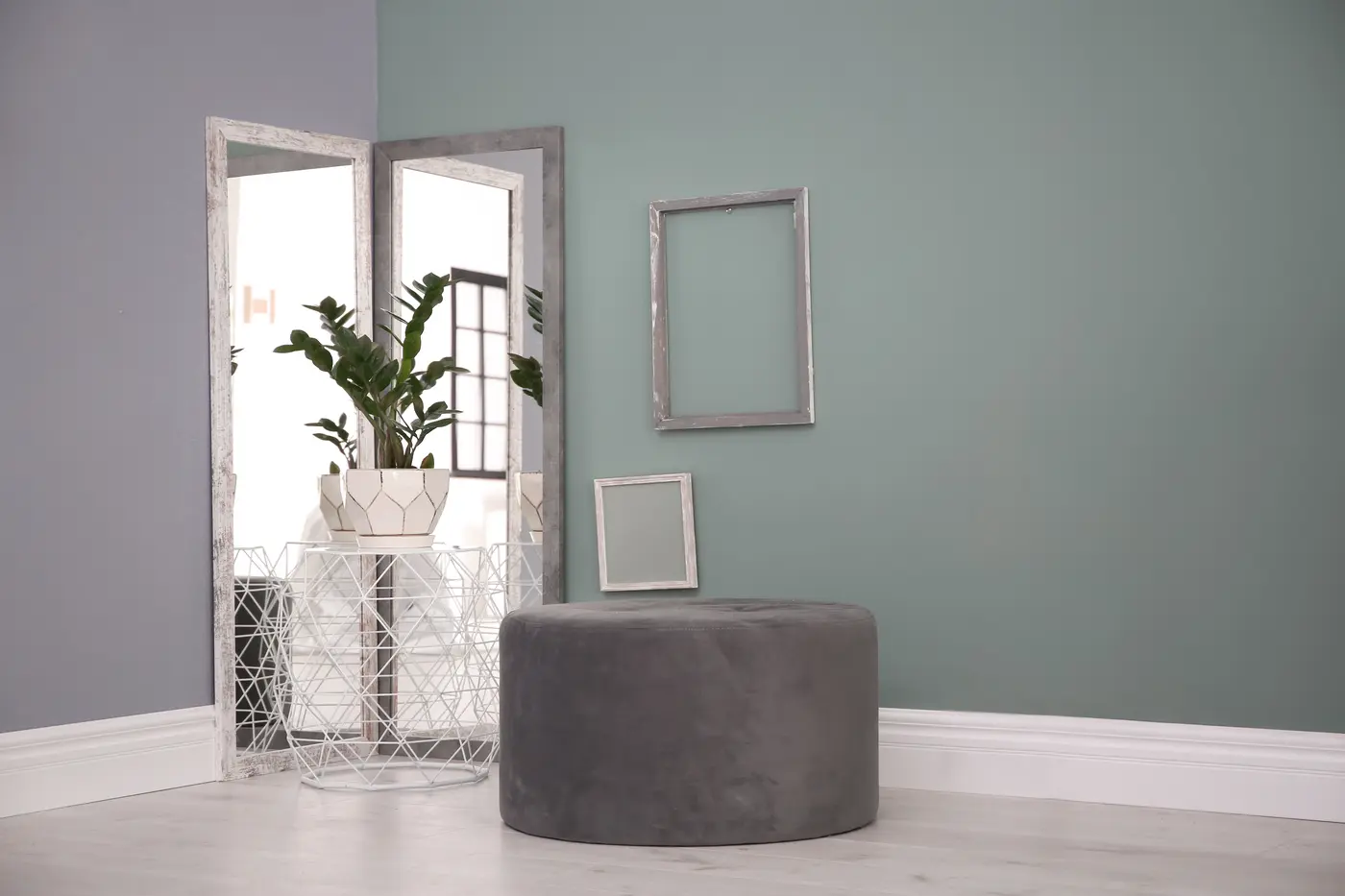
Venetian plaster
Traditional Venetian plaster is made from slaked lime and finely ground marble. It goes on in several very thin coats with a steel trowel, and each layer is pressed and smoothed into the one below it. On the final passes the trowel is used to burnish the surface, which compresses it and brings up a soft sheen. Depending on how far it is burnished, the result ranges from a satin, cloudy look to a high polish that reads close to stone.
Where it works
- Entries, stairwells and powder rooms where you want one surface to carry the room.
- Fireplace walls and range hoods as a feature.
- Living and dining rooms with good natural light, which shows off the depth.
What to know
Venetian plaster takes the most labor of the three, and the walls underneath need to be sound and flat because the thin coats show what is below them. Once cured, burnished plaster is hard-wearing. In wet or high-touch areas it is usually finished with a sealer or wax for extra protection. Small marks can often be blended in rather than repainting a whole wall, but that is skilled work, not a quick touch-up.
Limewash
Limewash is a thin, lime-based paint that is brushed on, usually in two or more coats, with loose, crossing strokes. It soaks into the surface rather than forming a thick film, and it dries to a flat, chalky, slightly cloudy finish. Each coat lightens as it dries, so the final color can look quite different from the wet coat. It has very little build and almost no sheen.

Where it works
- Whole rooms where you want a relaxed, washed, Old-World feel.
- Bedrooms and living spaces with a coastal or Mediterranean style.
- Masonry, brick and some exterior surfaces, where it has a long history of use.
What to know
Limewash bonds best to porous, mineral surfaces. Over existing latex paint, the wall typically needs a compatible primer first. Because it is so flat, it can mark more easily than a washable paint, and it is not the first choice for busy hallways or kids' rooms. If limewash interests you, ask about it during your estimate and we can talk through whether it suits the walls and the room you have in mind.
Roman clay
Roman clay is a troweled finish, usually made from lime or clay with fine aggregate, that sits between the other two. Like Venetian plaster, it is applied with a trowel in thin layers, so you get visible movement and soft variation. Unlike a burnished plaster, it is usually left matte or very low sheen, so it reads more like suede or fresco than polished stone.
Where it works
- Living rooms and bedrooms where you want texture without shine.
- Accent walls behind a bed or sofa.
- Modern and transitional homes where polished plaster would feel too formal.
What to know
Roman clay generally takes less time than a multi-layer burnished plaster but more care than paint. Many products can be sealed for better wipeability, which helps in a dining room or a family space.
Side-by-side: how to choose
- Want depth and a soft glow in an entry, powder room or fireplace wall: Venetian plaster.
- Want a flat, washed look across a whole room: limewash.
- Want movement without shine on a feature wall or living space: Roman clay.
- Need something very easy to scrub, like a mudroom or kids' hallway: a quality washable paint may serve you better than any of the three.
Light matters too. North County homes near the coast often get soft, diffused light under the marine layer in the morning, while inland rooms in Escondido or Ramona can get hard afternoon sun. Low-angle light exaggerates texture, so a finish that looks subtle at noon can look much stronger at sunset. That is a good reason to see samples on site.
Prep makes or breaks all three
Every one of these finishes is thin, and thin finishes show what is underneath. Before any troweling or brushing starts, the wall needs attention:
- Cracks, nail pops and dents repaired and sanded flat.
- Corners and edges straightened where they will catch the light.
- Glossy or incompatible paint primed with a product suited to the finish.
- Floors, trim and fixtures protected, since lime and plaster are messier to work with than paint.

If your walls have damage, we handle the drywall repair as part of the same job so the finish has a sound base.
Frequently asked questions
Can these finishes go in a bathroom?
Venetian plaster with a protective sealer or wax is the most common choice for powder rooms and some bathrooms. For a shower surround or a room with heavy steam, talk through ventilation and sealing first. Limewash is usually the least suited to wet rooms.
Can I go back to regular paint later?
Usually, yes. The wall may need sanding, a skim coat on heavier textures and a suitable primer before standard paint will sit evenly. Polished plaster takes more prep to cover than limewash.
Do they work on exterior walls?
Lime-based finishes have a long exterior history on masonry, and some products are made for outdoor use. In North County, salt air near the coast and strong sun inland both affect how an exterior finish weathers, so it is a site-by-site conversation. For most stucco homes, a standard exterior coating is the practical choice.
How do I know which one I will like?
Look at physical samples in your own light. Photos online are often heavily lit and edited. We can prepare sample boards so you can see each finish against your floors, trim and furniture before deciding.
Next step
If you are deciding between finishes, the simplest way forward is to look at the walls together and talk through how the room is used. For pricing factors, see our post on what venetian plaster costs in North County. When you are ready, get a free estimate or call Jovanni at (760) 852-7398.
More posts
What venetian plaster costs in North County, and why
Venetian plaster pricing swings widely. Here is what drives the number up or down: prep, size, height, polish, coats, access and sealing, and how to keep it in budget.

Painting an exterior in the Rancho Santa Fe Covenant
Inside the Rancho Santa Fe Covenant, exterior changes go through Association review. How to plan colors, samples and scheduling so a repaint runs smoothly.

Salt air on coastal stucco: how often the ocean side needs paint
Near the coast, the ocean-facing side of a stucco house wears out first. The warning signs, typical repaint cycles and how a coastal repaint should be done.